Revel App: increasing moped availability and usage for a shared electric ride service.
Role: Product Designer
Team: Individual project w/ feedback from mentor + peers
Duration: 80hrs
Tools: Figma, Google Forms
Problem
Revel is a ride-share service, operating in six different cities across the US. Though their electric mopeds are widely available, they often end up clumped together in popular areas, leaving some riders (like myself) without a nearby moped to rent. The current reservation feature allows for a 15 minute hold on mopeds but given that availability is a noted problem, I would like to explore how to increase moped availability and by extension, usage on their mobile app.
Solution
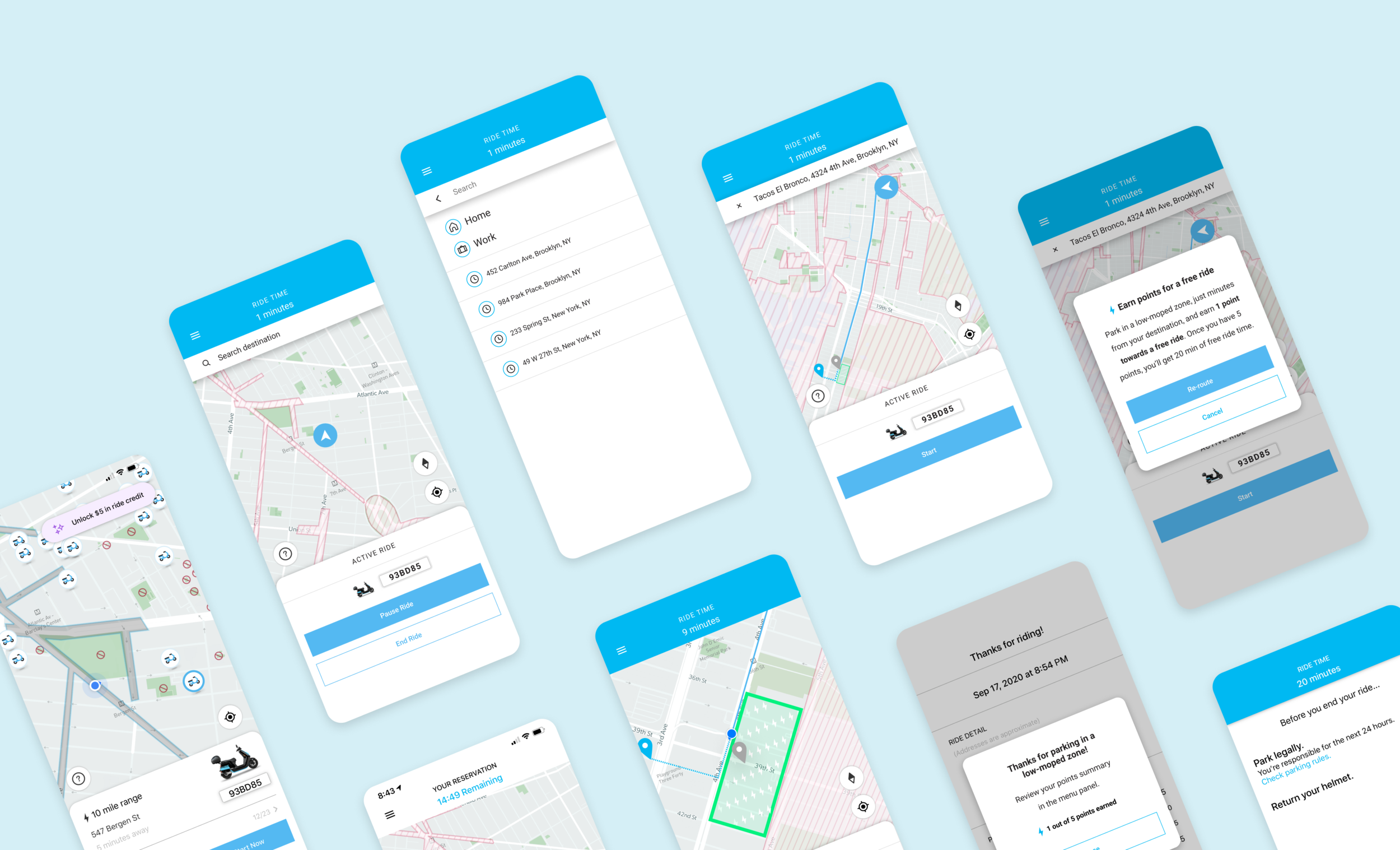
I designed a new feature and reward program that allows for in-app GPS navigation, with a reward incentive to park in designated ‘low-moped zones’ (if one is available near your destination).
Disclaimer: I am not an employee of Revel and this case study does not represent their official strategic direction.
UNDERSTANDING THE PROBLEM
Is this actually a problem?
Before diving into a solution, I wanted to understand user satisfaction and potential pain points with moped availability and the existing reservation system. I started by reading app reviews in the App Store, which confirmed my experience:
Revel App reviews on the Apple App Store
Let’s hear from the riders!
To take things a bit further, I enlisted 5 participants that identified as active Revel riders for a brief survey. After realizing that the survey lacked more open-ended questions that could provide deeper insight, I adjusted the questions and enlisted an additional 7 riders - for a total of 12 survey participants. Here are the key findings:
All riders have struggled to find an available moped at least once in their experience and if one isn’t available, 57% opt for another method of transportation.
57% of riders were only willing to walk 5-10 minutes to reach an available moped.
66% of riders use the Revel service during late afternoon or evenings.
54% of riders expect to use Revel round-trip and of these, only 40% pre-plan their departure.
Review the full research debrief report here.
Through these findings, I was able to confirm that Revel mopeds can be sparse depending on (1) your current location and (2) the time of day you’re trying to reserve.
IDENTIFYING A SOLUTION
Understanding the user
Based on the survey findings, I created a persona and journey map to help me understand and align with the core Revel audience. Meet Gabriel:
Persona and journey map for a Revel app user
Let’s brainstorm!
After thinking through potential solutions, there were two ideas that stood out as worth exploring:
Adding an in-app navigation feature
Creating an incentive or reward program for riders to spread out their mopeds when parking
Raw notes and sketches from a brainstorm session
Existing User Flow
Before proposing a new feature, I wanted to understand the existing user flow. I hopped on a Revel moped and took screenshots of the experience from beginning to end of the ride!
Existing Revel app user flow
In its current form, no destination input is available on the Revel map. Restricted parking / riding zones are shown as you navigate (red grid).
As the rider approaches their destination, there’s a potential area of opportunity to suggest parking in a low bike availability zone or at the outer edges of a restricted zone, in exchange for a reward. The app could suggest this on arrival to the rider’s destination or perhaps before when the destination is first put in.
User Flow Proposal
By adding in-app GPS navigation, users will not have to toggle between mobile apps for directions and a new feature can be introduced to encourage riders to park in low moped availability zones or at the edges of no parking zones.
Proposed new user flow with GPS navigation and a reward system for parking in a low moped zone
EXECUTE THE PLAN
Wireframes
Initial wireframes followed the existing design pattern of the Revel App, while introducing the following:
GPS navigation search bar
Navigation map
Modal introducing the low-moped parking reward system
Low fidelity wireframes for the added navigation and reward system features
UI Kit
Through a close audit of the existing Revel app, I built out the following style guide:
UI kit based on the existing Revel app design system
Hi-fi Mockups
In my initial mockups, the hypothesis was that with this new navigation feature, we could easily ask riders if they’d like to re-route to a parking location near their destination (if a low moped zone is identified). I created a prototype with these screens and used that for usability testing.
Initial hifi mockups used for the prototype, before usability testing
Usability Testing
I enlisted 3 participants for user testing and provided them with a prompt for end-to-end exploration of this new flow. All participants were able to complete the task and several important discoveries were made along the way:
Increased transparency - all participants chose to ‘reroute’ in order to earn points towards a free ride but they also commented on not having enough information for how this program worked.
Provide ability to correct mistakes - two participants were concerned with trusting the reroute and asked if it was possible to go back to the original route.
More visual prompts - all participants asked if there were other low-moped zones outside of the one they were being redirected to.
Revisions
I updated the prototype based on findings from usability testing:
New modal prompt with more information about how the reward system works.
Updated navigation route showing distance from low-moped zone to your actual destination.
Updated indicator for low-moped zones in a more appropriate color-way that contrasts restricted zones.
New closing prompt that reiterates points earned and where to review current point status.
Prototype
This prototype runs through the end-to-end process of reserving a ride, starting that ride, and using the in-app GPS feature and re-route prompt for parking in a nearby ‘low-moped zone.’ Try the prototype below (it’s expandable) or click here to open it separately.
Summary
Adding a feature to an existing application, without having direct access to the team that helped build it was definitely a challenge! That being said, the design process was pivotal in breaking down this perceived problem and exploring potential solutions that I then validated with real users. The proposed solution of in-app GPS navigation and a rewards program that introduces the concept of ‘low-moped zones,’ is one of many possibilities to explore. In evaluating if this is a good decision, I would look to more thorough user testing and, I’d partner with product management and engineering to understand the feasibility of calculating bike availability based on a person’s intended destination.